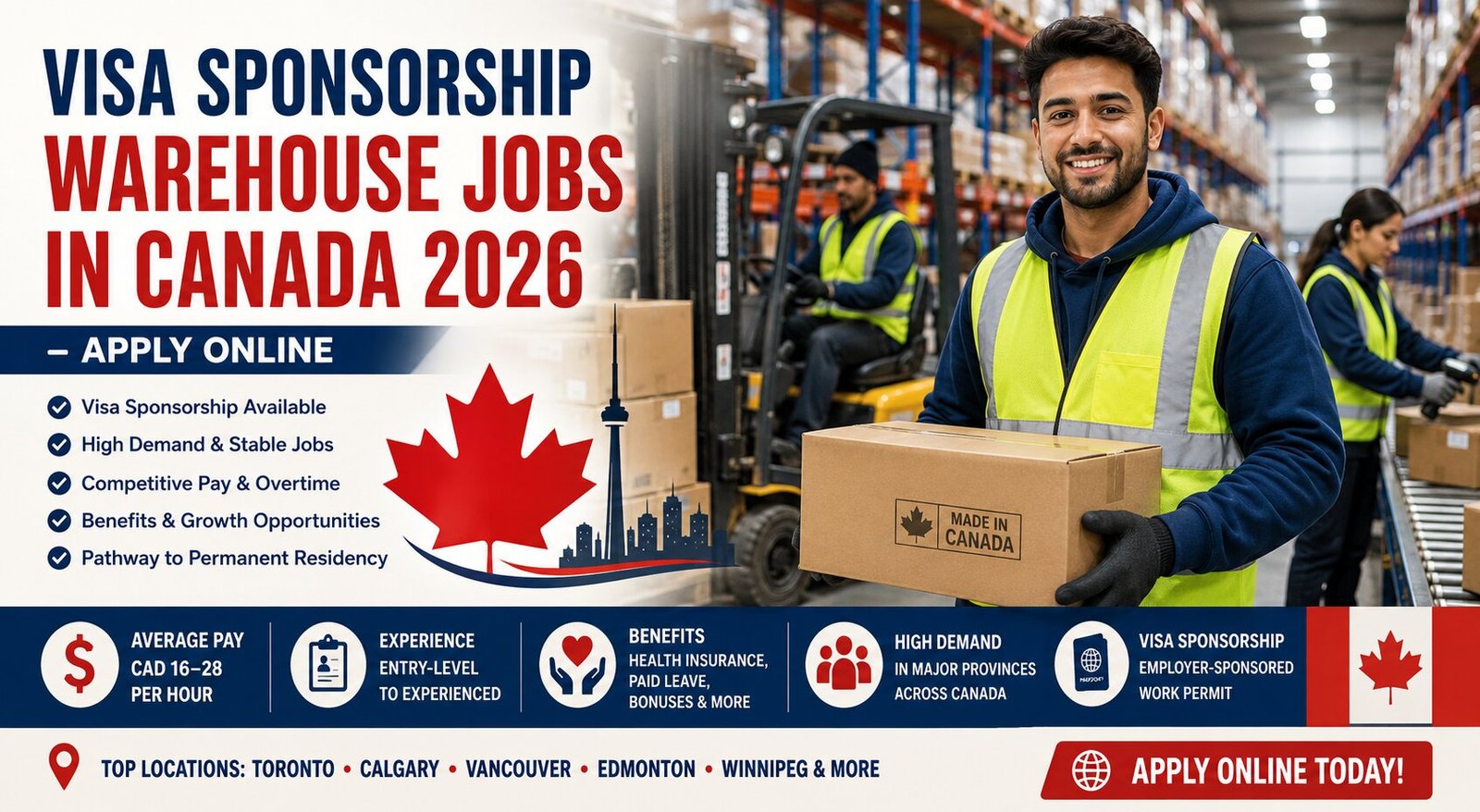
Visa Sponsorship Warehouse Jobs in Canada 2026: Complete Guide for Foreign Workers
Many people want to go outside their country to get a good job, earn more money, and improve the future of their family. That is why Canada is one of the countries in the world where people like to go to work. Canada has a strong economy, workers’ rights are taken care of there, and there is a shortage of workers in many sectors. That is why Canada continues to provide jobs to foreign workers.
Visa Sponsorship Warehouse Jobs in Canada in 2026 are becoming increasingly popular as many Canadian companies are looking for honest and hardworking people to work in warehouses, packing centers, and logistics companies. The need for warehouse workers is constantly increasing due to the growing business of online shopping, retail, and factories, and it is expected that the demand for these jobs will remain high in 2026.
These jobs offer good hourly pay, overtime, employee benefits, and for some, permanent residency (PR) opportunities. But many people don’t know how to apply, what visa sponsorship is, who can apply, and how to increase their chances of getting the job.
In this comprehensive guide, you’ll learn in simple language how to get warehouse jobs in Canada with visa sponsorship, how much they pay, what you need, and what you need to do to be successful.
Table of Contents
- Overview of Visa Sponsorship Warehouse Jobs in Canada
- Why Warehouse Jobs are in Demand in Canada
- Key Highlights of Warehouse Jobs in Canada 2026
- Average Salary and Benefits
- Types of Warehouse Jobs Available
- Key Duties and Responsibilities
- Who Can Apply for These Jobs
- Required Skills and Qualifications
- Visa Sponsorship Explained
- Canadian Work Permit Options for Warehouse Workers
- Best Provinces for Warehouse Jobs in Canada
- Top Companies Hiring Warehouse Workers
- Step-by-Step Guide to Applying Online
- Documents Required for Application
- How to Create a Strong Canadian-Style Resume
- Common Interview Questions
- Tips to Increase Your Chances of Selection
- Common Mistakes to Avoid
- Pros and Cons of Warehouse Jobs in Canada
- Being an International Worker Real-world examples
- Conclusion
Overview of Visa Sponsored Warehouse Jobs in Canada
Warehouse jobs in Canada involve handling goods, organizing items, packing, loading goods into trucks, and assisting with supply chain operations. These jobs are considered essential for industries such as retail, manufacturing, transportation, food supply, and e-commerce.
Many companies in Canada are facing a shortage of workers because there is more work but fewer workers. That is why many companies hire people from other countries. Visa sponsorship means that the company supports the foreign worker to work legally in Canada.
Warehouse jobs are mostly considered entry-level jobs, but they offer good earnings and opportunities for advancement. Some people also become supervisors, forklift operators, or logistics managers later on.
The warehouse industry is expected to grow even more in 2026 due to the rise of online shopping. Major Canadian cities such as Toronto, Calgary, Vancouver, Edmonton, and Winnipeg have large warehouses and logistics centers where new hires are often made.
These jobs are considered especially good for foreigners because they do not require much education. Companies want people who are hardworking, punctual, can work with a team, and are willing to work in different shifts.
Why are warehouse jobs in demand in Canada
The warehouse and logistics sector in Canada has grown rapidly in the past few years. The main reason for this is the increase in online shopping. People now buy most things online, so companies need more warehouses and more workers.
Another reason is that many older employees in Canada are retiring. New people are needed to replace them, but there are not enough local workers. That’s why companies hire foreigners.
These industries are seeing the biggest growth in warehouse jobs:
- Supermarkets and retail chains
- E-commerce companies
- Factories
- Pharmaceutical supply companies
- Food and beverage distribution companies
- Construction equipment supply companies
- Transport and logistics companies
Warehouse jobs also increase depending on the season. People shop more, especially during the holidays, Eid, Christmas, and shopping seasons. At this time, orders come to warehouses a lot, so companies hire additional workers to complete the work quickly.
The Canadian government also supports programs through which foreign people can come to work legally. The government wants people from other countries to come and work in sectors where there are fewer workers. Warehouse and logistics are also among these important sectors.
For all these reasons, warehouse jobs in Canada in 2026 can be a good and easy opportunity for foreigners, especially for those who are looking for a job with visa sponsorship.
Key Highlights of Warehouse Jobs in Canada 2026
| Category | Details |
| Job Type | Full-Time / Part-Time |
| Industry | Warehouse & Logistics |
| Visa Sponsorship | Available with selected employers |
| Average Salary | CAD 16–28 per hour |
| Experience Required | Entry-level to experienced |
| Education | High school preferred |
| Work Permit | Employer-sponsored |
| Overtime | Often available |
| Benefits | Health insurance, paid leave, bonuses |
| Demand Level | High in major provinces |
Average Salary and Benefits
Warehouse jobs in Canada are not the same everywhere. Salaries vary depending on the city you work in, how much experience you have, how big the company is, whether you work day or night shifts, and what your responsibilities are.
People who are new to warehouse work usually earn less. But those who have experience or know how to operate a forklift can earn more.
Most warehouse workers can earn around $16 to $25 per hour. Some larger companies also offer extra money for working night shifts or overtime.
Many companies offer the following benefits:
- Additional overtime pay
- Medical and health insurance
- Paid vacations
- Bonuses
- Employee training
- Permanent residency, i.e. PR opportunities
If a person works hard and honestly, both their salary and position can improve over time
.Average Warehouse Salaries in Canada
| Position | Average Hourly Wage |
| Warehouse Associate | CAD 16–22 |
| Forklift Operator | CAD 20–28 |
| Picker/Packer | CAD 16–21 |
| Inventory Clerk | CAD 18–25 |
| Shipping Coordinator | CAD 20–30 |
| Warehouse Supervisor | CAD 25–35 |
Types of Warehouse Jobs Available
Warehouse work includes many different jobs. The responsibilities can also vary depending on the company. Some jobs involve more physical labor, while others involve more computer, inventory, and inventory record work.
- Warehouse Associate
Warehouse associates help organize inventory in the warehouse, receive new shipments, and prepare orders for delivery. This is considered one of the most common entry-level jobs and is where most people start.
- Pickers and Packers
These workers remove the desired products from the shelves and pack them according to the customer’s order. Speed and accuracy are essential in this work so that the wrong goods are not sent.
- Forklift Operator
Forklift operators move large and heavy items from one place to another. A special machine called a forklift is used for this work. Some companies also require a forklift certificate.
- Inventory Clerk
Inventory clerks keep records of inventory. They keep track of how much of each item is in the warehouse and what is running low. This job may involve using a computer.
- Shipping and Receiving Clerk
These employees check incoming and outgoing goods. They review documents, check the condition of the goods, and make sure the right order is sent to the right place.
- Warehouse Supervisor
Supervisors oversee the entire team. They monitor the pace of work, help workers, and make sure everyone follows safety rules.
Key Duties and Responsibilities
The duties of warehouse workers can vary by company and job, but typically include:
- Loading and unloading goods
- Labeling products
- Keeping goods in order
- Using warehouse machinery
- Packing customer orders
- Keeping inventory records
- Checking for damaged goods
- Maintaining cleanliness
- Following safety rules
- Preparing goods for delivery
- Working with a team during busy times
In many warehouses, workers have to stand for long periods of time and sometimes lift heavy goods. That’s why companies like people who are physically fit, punctual, and can work well with a team.
Who can apply for these jobs?
Visa sponsorship warehouse jobs in Canada are considered good for people from different countries of the world. Companies are looking for workers who are hardworking, responsible, and willing to do physical work.
Applicants may include:
- Foreign workers looking for work abroad
- New graduates looking to gain international experience
- Logistics and supply chain workers
- People with factory or warehouse experience
- People looking for entry-level jobs in Canada
- Candidates looking to obtain Canadian permanent residency in the future
Most warehouse jobs do not require a major university degree. This makes it easy for people with a variety of educational backgrounds to apply.
However, each applicant must meet the company’s requirements and Canadian immigration laws.
Required Skills and Abilities
Although most warehouse jobs are entry-level, companies still prefer people who are responsible, hardworking, and can work well.
General Requirements
These are the things that are considered essential for most warehouse jobs:
- Ability to speak and understand basic English
- Physical strength and fitness
- Ability to lift heavy boxes or items
- Habit of completing tasks on time
- Ability to work as a team
- Attention to detail
- Punctuality and responsibility
- Basic computer skills
Additional Qualifications
Some companies prefer people who have prior experience, such as:
- Previous warehouse experience
- Forklift certification
- Driver’s license
- Understanding of safety rules
- Experience using a barcode scanner or warehouse software
If someone doesn’t have experience, don’t worry. Many companies also provide on-the-job training for new workers.
Visa sponsorship explained
Visa sponsorship means that a Canadian company helps a foreign person to work legally in Canada.
Most companies first have to get permission from the government. This process is called an LMIA. This means that the company first looked for local people but could not find suitable workers, so now it wants to hire foreign workers.
Once the company is approved, the foreign worker can apply for a work permit.
It is important to remember that not every warehouse job offers visa sponsorship. Some companies only hire people who are already in Canada or have legal permission. That is why it is important to read the job description carefully before applying.
Real and legitimate companies usually provide this information clearly:
- Work permit assistance
- Employment contract
- Salary details
- Working hours
- Responsibilities
- Accommodation or travel assistance if available
Always avoid people or agents who ask for a lot of money up front or make unrealistic promises.
Canadian Work Permit Options for Warehouse Workers
There are various programs in Canada through which foreigners can get warehouse jobs.
Temporary Foreign Worker Program
This is one of the most common programs. When companies have a shortage of workers, they hire foreigners through this program.
Provincial Nominee Program
Some provinces in Canada run programs through which foreign workers are invited to work in sectors where there is a need.
Express Entry
Warehouse jobs do not always give high points in this program, but Canadian experience can improve your chances of getting permanent residency later on.
Seasonal or regional programs
Some small towns or rural areas also need warehouse workers, so foreigners can be hired there.
Before applying, everyone should read the government’s immigration laws carefully and keep all the documents correct.
Best provinces for warehouse jobs in Canada
Some provinces in Canada have more warehouse and logistics jobs because they have factories, ports, and a large transportation system.
Ontario
This is one of the largest logistics regions in Canada. Thousands of warehouse jobs are available in cities like Toronto and Mississauga.
Alberta
This province is growing rapidly in the retail, transportation, and manufacturing sectors. Calgary and Edmonton are major employment centers.
British Columbia
This province’s ports are very important for international trade, so warehouse workers are in high demand here, especially in Vancouver.
Manitoba
Winnipeg is located in the center of Canada, which is why it has become an important city for transportation and warehousing operations.
Quebec
Montreal has large factories and distribution centers where new warehouse workers are often hired.
Major Companies Hiring Warehouse Workers in Canada
Many major companies in Canada are regularly hiring new workers for their warehouses and logistics centers. Due to the rise of online shopping and the increased volume of goods shipped, these companies need more employees every year.
Although not every company offers visa sponsorship, some foreigners may still be able to find a job due to special hiring programs or labor shortages.
Here are some of the main industries and companies where warehouse jobs are often found.
E-commerce and retail companies
Major shopping and online shopping companies operate large warehouses and distribution centers across Canada. These locations require workers to pack, sort, and ship goods.
Common companies include:
- Amazon
- Walmart
- Costco
- Canadian Tire
These companies are particularly hiring during the shopping season and holidays.
Logistics and Transportation Companies
These companies handle the shipping, storage, and distribution of goods.
Popular companies include:
- DHL
- FedEx
- UPS
These companies can be physically demanding, but the job is often permanent and stable.
Food and Manufacturing Warehouse
Companies related to food, pharmaceuticals, and factories also hire warehouse workers.
These sectors include:
- Food packaging
- Beverage distribution
- Pharmaceutical storage
- Industrial factories
- Construction equipment supply companies
Applicants should regularly check the companies’ official websites and career pages for new job openings and visa sponsorship information.
Step-by-step guide to applying online
Good preparation is essential when applying for Canadian warehouse jobs in 2026. Many people fail simply because they submit an incorrect or incomplete application.
If you follow the right approach, your chances of getting a job can increase significantly.
Step 1: Find real and legitimate jobs
First, look for reliable job websites and official career pages of companies.
Look for jobs that have these words written on them:
- Visa Sponsorship
- LMIA Support
- Foreign Workers Accepted
- Work Permit Support
Avoid websites that charge a high fee upfront or offer a 100% job guarantee.
Step 2: Create a Canadian-style CV
Most companies in Canada prefer simple and clean CVs.
Be sure to include the following information in your CV:
- Name and contact information
- Work experience
- Education
- Certificates
- Language skills
- Warehouse or factory experience
The CV should not be too long or complicated
Step 3: Write a good cover letter
A cover letter is a short letter in which you tell the company:
- Why you want to work in Canada
- What experience you have
- Why you are hardworking and responsible
- You are willing to relocate
A cover letter written in a personal style makes a better impression than a generic application.
Step 4: Submit an online application
You can apply from a variety of places, such as:
- The company’s official website
- Canadian job websites
- Recruitment agencies
- Government-approved platforms
Always double-check your spelling, information, and uploaded files before submitting your application.
Step 5: Conduct an online interview
Many companies interview foreign candidates via video call.
The following are frequently asked questions in interviews:
- Previous work experience
- Ability to perform physical work
- Availability to work in shifts
- Understanding of safety principles
- Experience working with a team
Good communication and trust are very important.
Step 6: Work permit and visa process
If the company selects you, they can start the visa sponsorship process.
You may then need to submit additional documents for a work permit, such as:
- Passport
- Medical report
- Police clearance
- Educational or experience certificates
All documents should always be correct and up-to-date so that there are no problems with the visa process
Required Documents for Application
Different companies may ask for different documents when applying for a warehouse job in Canada, but most companies require some important documents. If you have all the documents ready in advance, applying becomes easier and faster.
Required Documents
Most warehouse jobs may require the following documents:
- Updated CV or resume
- Copy of passport
- Educational certificates
- Letters of experience from previous jobs
- Language test results if necessary
- Police clearance certificate
- Medical report
- Passport-sized photographs
Additional Documents
Some companies may also ask for additional documents, such as:
- Forklift certificate
- Safety training certificate
- Driver’s license
- Reference letters from previous employers
It is best to keep clean digital copies of all documents on your phone or computer so that they can be uploaded immediately if needed.
How to Create a Strong Canadian-Style Resume
A good resume plays a huge role in landing a job abroad. Canadian companies often receive hundreds of applications, so your CV should be simple, clean, and easy to read.
Top Resume Tips
- Use clear headings
- Keep the font simple and professional
- Limit your CV to 1 or 2 pages
- Focus more on your skills and experience
- Avoid unnecessary design and images
Work Experience
List your previous jobs in order.
Include this information for each job:
- Job title
- Company name
- Date of employment
- Key responsibilities
- Achievements or additional skills
Skills section
List your key skills clearly, such as:
- Inventory management
- Forklift operation
- Packing and shipping
- Physical strength
- Teamwork
Common resume mistakes
Avoid these mistakes when creating a CV:
- Spelling mistakes
- Incorrect information
- Paragraphs that are too long
- Unprofessional email address
- Unnecessary work information
A clean, professional, and well-crafted resume makes a good first impression on the company and increases your chances of getting the job.
Common Interview Questions
In warehouse job interviews, companies mostly look at how responsible, hardworking, and a team player the candidate is. If you prepare in advance, you will feel more confident in the interview.
- Why do you want to work in Canada?
The company wants to know what your interests are and whether you want to work seriously.
You can simply say that you want a better future, a good job, and international experience.
- Do you have warehouse experience?
If you have previous experience, tell about it. If not, mention the skills that can help in this job, such as teamwork, hard work, or physical labor.
- Can you do physical work?
Warehouse work may involve standing for long periods of time, lifting materials, and working in a fast-paced environment. The company wants to know if you can handle this work.
- Have you used warehouse equipment before?
If you have used a forklift, barcode scanner, pallet jack, or inventory system, be sure to tell us.
- How do you work in a busy environment?
Companies like people who can stay calm under pressure and work well with a team. Give an example from your life or previous job.
Important interview tips
- Dress neatly and professionally, even in a video interview
- Speak confidently
- Have a good internet connection
- Learn about the company first
- Arrive on time for the interview
- Speak respectfully
Most companies prefer honesty and a good attitude over rote answers.
Important tips to increase your chances of selection
International jobs are very competitive, especially those that require visa sponsorship. If you keep a few important things in mind, your chances of success can increase.
Apply early
Many companies accept limited applications. Early applicants often get more attention.
Learn basic warehouse skills
You can strengthen your profile by taking short training courses in forklift, safety rules, or inventory management.
Improve your English
Good English helps a lot in interviews and day-to-day work.
Customize your CV for each job
Don’t send the same CV everywhere. Highlight your skills according to the job requirements.
Use the legal method
Always apply according to government regulations and the legal method to avoid scams and immigration issues.
Common mistakes to avoid
Many people fail to get a good job because of small mistakes. If you avoid these mistakes, your chances of success can increase.
Applying without reading the requirements
Each job has different rules. Some companies only hire people who are already in Canada, while others offer visa sponsorship.
Using fake documents
Incorrect information or fake documents can lead to permanent bans or legal problems in the future.
Using a weak CV
A resume with errors or incompleteness is often rejected immediately.
Paying money to fake agents
Avoid people who offer 100% job or visa guarantees.
Not preparing for the interview
Unprepared candidates often cannot answer even simple questions confidently.
Sending the same application everywhere
It is better to send a good application for each job instead of applying in large numbers.
Avoiding these mistakes will make you look more professional and may improve your chances of getting a job in Canada.
Pros and Cons of Warehouse Jobs in Canada
Understanding both the advantages and challenges of warehouse employment helps applicants make informed career decisions.
| Pros | Cons |
| Stable employment opportunities | Physically demanding work |
| Competitive hourly wages | Shift-based schedules |
| Overtime earning potential | Repetitive tasks |
| Entry-level accessibility | Cold weather in some regions |
| Possible visa sponsorship | Long standing hours |
| Career growth opportunities | Busy peak seasons |
For many international workers, the benefits outweigh the challenges, especially when long-term career and immigration goals are considered.
Real-life example of an international worker
A young man from South Asia dreamed of getting a warehouse job in Canada. He had about two years of experience working in a warehouse in his home country. He started looking for a job in Canada for a better future.
First, he improved his English so that he could speak confidently in interviews. Then, he completed forklift safety training and obtained a certificate, which further strengthened his profile.
He submitted applications through the official websites of various companies. After some time, he was called for an online interview by a logistics company in Ontario. After the interview was successful, the company helped him with the work permit process.
After arriving in Canada, he started working the evening shift at a distribution center. His job was to handle inventory, pack goods, and prepare shipments.
At first, the cold weather, long shifts, and new surroundings were difficult for him, but he didn’t give up. Gradually, he learned the warehouse management system and gained more experience.
After some time, the company, seeing his hard work, promoted him to a supervisory support role. This experience gained in Canada later also helped improve his chances of immigration and permanent residency.
This example shows that if a person works hard, is patient, improves his skills, and applies legally, it is possible to get a good job in Canada.
Who should apply for warehouse jobs in Canada?
Warehouse jobs in Canada can be good for a variety of people. These jobs are mostly hands-on and hard-working, so a high degree is not required. This is why people with a variety of educational and professional backgrounds can apply for these jobs.
Entry-level job seekers
People who don’t have much experience can also apply for warehouse jobs. If someone is hardworking, punctual, and willing to learn, the company may give them a chance.
Experienced warehouse workers
People who have previously worked in warehousing, packing, shipping, or inventory management may have a higher chance of being selected because they already have the necessary skills.
Workers with International Experience
Many people use warehouse jobs in Canada as a stepping stone to their international careers. This experience can lead to better jobs and immigration opportunities later on.
Physically active people
Warehouse work often involves walking, standing, lifting, and constant movement. People who are used to physical work can adjust quickly to this environment.
Candidates seeking future advancement
Some people start with entry-level warehouse jobs and later advance to various senior positions, such as:
- Warehouse Supervisor
- Inventory Coordinator
- Supply Chain Staff
- Logistics Assistant
- Forklift or Machine Operator
Canadian work experience can also make it easier for some people to gain permanent residency.
Who might find warehouse work difficult?
Although warehouse jobs offer great opportunities, they are not easy for everyone. Understanding the challenges beforehand can help you make a better decision.
People who find physical labor difficult
Warehouse work often involves:
- Lifting heavy loads
- Standing for long periods of time
- Working quickly
- Working in different shifts
For those with physical disabilities, this job can be difficult.
People used to working only in an office
The warehouse environment is not as calm as an office. There is constant movement and hands-on work, so people who prefer desk jobs may find it difficult.
People who are bothered by the shift system
Many warehouses operate around the clock, so employees may occasionally have to:
- Night shifts
- Weekend duties
- Overtime
That’s why it’s important to be flexible.
People who are not prepared for cold weather
Winter is very harsh in many areas of Canada. The weather can be difficult, especially when working outside loading or transporting goods.
Being mentally and physically prepared can help international workers adjust more easily to the Canadian environment.
Understanding Canadian Workplace Culture
Working abroad is not just about getting a new job, but also about getting used to a new environment and new work habits. Companies in Canada generally place great value on professionalism, punctuality, safety, and teamwork.
If an employee understands and follows these principles, it will be easier for them to succeed in their job.
The Importance of Workplace Safety
Workplace safety in Canada is very strict. Every employee is expected to take care of their own safety and the safety of others.
Workers are often required to:
- Wear protective clothing and equipment
- Follow company policies
- Report dangerous situations immediately
- Participate in safety training
If an individual ignores safety rules, the company may also take action against them.
Teamwork and good communication
A warehouse is a place where different people work together, such as:
- Workers
- Supervisors
- Drivers
- Inventory staff
That is why it is very important to communicate well with each other.
Good communication has these benefits:
- Work is completed faster
- Order errors are reduced
- Team work is better
- Employee relations are good
Punctuality
In Canada, being on time is considered very important. If someone is repeatedly late, the company may view their performance negatively.
That is why employees should:
- Arrive at work on time
- Take care of shifts
- Complete work on time
Equal treatment of all
People from different countries and cultures work together in Canada. Respect and equality are very important in the workplace.
Every employee is expected to:
- Respect others
- Not discriminate based on race, language, or religion
- Maintain a professional demeanor
These good habits help to ensure a successful job in the long run.
Costs of Living in Canada for Warehouse Workers
It is important to understand the cost of living before moving to Canada. While salaries are higher than in many countries, living there can also be quite expensive, especially in large cities.
Key daily expenses may include:
- Rent
- Food
- Transportation
- Electricity and internet
- Cell phone bills
- Clothing and personal needs
For example, housing costs are higher in cities like Toronto and Vancouver, while costs may be relatively lower in some smaller cities.
Many new workers initially live in shared apartments to keep costs down.
If a person budgets and avoids extra expenses, they can live better on their income.
Common Monthly Expenses
| Expense | Estimated Monthly Cost |
| Shared Accommodation | CAD 500–1200 |
| Transportation | CAD 80–180 |
| Food & Groceries | CAD 250–500 |
| Mobile & Internet | CAD 70–150 |
| Utilities | CAD 80–200 |
The cost of living in large cities like Toronto and Vancouver is generally high. In contrast, rent and daily expenses in smaller towns or rural areas can be relatively low.
Ways to Save Money
Many international workers use a variety of methods to reduce their expenses in Canada, especially in the early months.
Common methods include:
- Sharing accommodation with others
- Using public transportation
- Cooking at home
- Working overtime shifts
- Buying second-hand furniture or clothing
It is important to budget and spend in the first few months to reduce financial stress.
Are warehouse jobs in Canada permanent?
Not every warehouse job in Canada is permanent. Some jobs are only for a specific time or season, while some companies hire employees for a long time.
Temporary Jobs
Some companies only hire additional workers during busy seasons, such as:
- Holiday shopping season
- Summer rush
- During inventory growth
Such jobs may last for a few months.
Permanent Full-Time Jobs
Many large companies also offer permanent jobs to reliable and hardworking workers. These jobs often include additional benefits, such as:
- Health insurance
- Vacations
- Overtime
- Opportunities for advancement
Contract-Based Jobs
Some staffing agencies hire workers for a specific period of time. If the worker performs well, he or she may later get a permanent job.
It is very important to read the contract carefully before accepting a job.
Safety Rules in Canadian Warehouses
Safety is very important in a warehouse because machines, heavy equipment, and various tools are used there.
General safety rules
Most workers are required to:
- Wear sturdy safety shoes
- Use a reflective safety vest
- Lift items correctly
- Use machinery carefully
- Keep walkways clear
- Report damaged equipment immediately
Forklift and machine safety
Only trained or certified individuals are allowed to operate these machines:
- Forklifts
- Pallet jacks
- Conveyor systems
- Loading machinery
Companies often provide additional safety training to reduce accidents.
Emergency rules
Canadian companies have clear emergency rules, such as:
- Fire safety
- Help in case of injury
- Reporting hazards
- How to evacuate the building
Following safety rules is beneficial for both the worker and the company.
Can warehouse jobs be a path to permanent residence, i.e. PR?
Many foreign workers want to obtain permanent residence after working in Canada. While a warehouse job does not automatically guarantee PR, Canadian experience can improve your chances of immigration in the future.
Potential Immigration Pathways
Some people may later qualify through these programs:
- Provincial Nominee Program (PNP)
- Canadian Experience Class
- Regional Immigration Program
- Employer-assisted immigration pathways
Important Factors for PR
Immigration eligibility often depends on:
- Work experience
- English or French language
- Job type
- Provincial requirement
- Age and education
Canada’s immigration laws can change over time, so it’s always important to check official information.
How to Avoid Job Scams
Unfortunately, some fake people and fraud agents try to scam job seekers abroad. That’s why it’s important to be very careful when looking for a job in Canada.
If you know the signs of fake jobs in advance, you can protect your money, time, and personal information.
Common Signs of a Fake Job
Some scammers make promises that are not actually true. Be especially careful of these things:
- Asking for a lot of money before the job
- Giving a 100% visa or job guarantee
- Offering a job right away without an interview
- Unprofessional emails or messages
- Fake or suspicious company websites
- Rushing to provide passport or personal information
If a company is too pressuring or asking for a quick decision, it’s important to be careful.
How to Find a Job Safely
Always take these precautions to protect yourself:
- Apply only from the company’s official website
- Check company information online
- Get information from official immigration websites
- Never give out your bank passwords or confidential information to anyone
- Read and sign every document
How do legitimate companies work?
Real and legitimate companies usually have a thorough and organized recruitment process, such as:
- Formal application forms
- Interviews
- Written job offers
- Clear salary and contract
- Accurate work permit information
If something seems too easy or unrealistic, it is important to research it thoroughly.
Caution and common sense can protect you from scams and help you get a job in Canada safely.
Important English Terms Used in Warehouses
Understanding basic workplace vocabulary can help international workers adjust more easily.
| Term | Meaning |
| Inventory | Products stored in the warehouse |
| Shipment | Goods being transported |
| Pallet | Flat platform used for moving goods |
| Packing Slip | Document listing shipment contents |
| Overtime | Extra working hours |
| Loading Dock | Area where trucks are loaded/unloaded |
| Barcode Scanner | Device used to track products |
Improving workplace English communication can support both safety and productivity.
Expert Tips for Long-Term Career Growth
A warehouse job is not just an ordinary job. If a person focuses on hard work, learning, and development, this job can also be a path to better positions and bigger jobs in the future.
Many people start out in warehouse jobs and later move up to positions such as supervisor, logistics staff, or supply chain management.
Learn new practical skills
Workers’ chances of advancement increase if they continue to learn new things.
For example:
- Using warehouse systems
- Operating a forklift
- Inventory management
- Shipment tracking
- Using a barcode scanner
Workers with more skills are considered more valuable to the company.
Maintain good attendance
Companies in Canada consider punctuality and consistent attendance to be very important.
If an employee:
- Arrives on time
- Does not take unnecessary leave
- Works responsibly
, the company trusts him more and opportunities for advancement increase.
Improve English Communication
The ability to speak and understand good English can help you achieve leadership roles in the future.
With better communication, employees:
- Can communicate more easily with supervisors
- Can understand the team better
- Can make a good impression in interviews
Earn useful certificates
Some additional certificates can strengthen your career, such as:
- Forklift operation certificate
- Workplace safety training
- First aid training
- Inventory software systems training
These certificates can open up new job opportunities.
Build professional relationships
A good attitude and positive relationships with supervisors and coworkers will pay off in the future.
Good relationships can:
- Get better recommendations
- Increase opportunities for advancement
- Get information about new jobs
Better career opportunities in the future
Workers who continue to learn and improve their skills can later move into these fields:
- Logistics coordination
- Transportation management
- Supply chain management
- Warehouse supervisory roles
Hard work, patience, and a habit of continuous learning can play a key role in long-term success in Canada.
Common Challenges International Workers Face
Working in another country can be a great opportunity, but it also comes with some challenges. If workers understand these challenges in advance, it will be easier for them to adjust to the new environment.
Adjusting to the Weather
Winter is very harsh in many parts of Canada. People coming from warmer countries may find the extreme cold difficult at first.
That’s why new workers should:
- Buy warm clothes
- Get information about the weather
- Learn how to travel in snow and cold
Over time, most people get used to the new climate.
Communication in the Workplace
In the early months, some people may have difficulty understanding the English accent and work style.
For example:
- Different accents
- Fast-paced conversation
- New vocabulary
- Workplace rules
A person’s confidence can improve if they practice English every day.
Managing Expenses
Some new workers may not be able to fully understand the costs of living in Canada at first.
Initial expenses may include:
- A deposit on a house
- Transportation
- Food and drink
- Winter clothes
- Mobile phone and internet
That is why financial planning is so important before moving to Canada.
Missing family
Many people miss their family and friends at first. Living alone in a new country can sometimes be stressful.
The following things can help in this situation:
- Keeping in touch with family
- Making new friends
- Participating in positive activities
- Taking care of your rest and health
New technology in Canadian warehouses
Today, modern warehouses use new technology to make work faster and easier.
Commonly used technologies
Many warehouses now use these systems:
- Barcode scanners
- Inventory tracking software
- Automated sorting systems
- Conveyor belt technology
- Digital scheduling tools
Workers who learn new technologies can find it easier to get good jobs.
Will machines eliminate warehouse jobs?
Technology is changing warehouse operations, but human workers are still essential.
Human workers still play important roles, such as:
- Quality checking
- Inventory monitoring
- Complex packaging
- Inventory management
- Logistics coordination
Technology often doesn’t eliminate jobs, but creates a need for new skills.
Seasonal Warehouse Hiring in Canada
Warehouse companies need more workers during certain months.
- Peak hiring seasons
- Shopping season
Large companies often hire more employees before these occasions:
- Black Friday
- Christmas shopping
- New Year’s sales
Why are seasonal jobs important?
Sometimes seasonal jobs can later turn into permanent jobs, especially if the worker performs well.
People who:
- Can work a variety of shifts
- Are willing to work overtime
- Work responsibly
have a higher chance of getting a permanent job.
How do Canadian employers view international candidates?
Canadian companies often receive applications from many different countries, especially for jobs with visa sponsorship.
What do employers consider most important?
Most companies are not looking for perfect people, but reliable workers.
Employers typically look for:
- Good attendance
- Positive attitude
- Willingness to learn
- Teamwork
- Ability to work consistently under pressure
________________________________________
Practical skills are more important
Practical skills are considered very important in warehouse jobs.
For example:
- Lifting weights safely
- Handling inventory
- Using machinery
- Completing work on time
- Preparing accurate packaging and shipments
Good English is an advantage
Although complete fluency in English is not necessary, speaking clearly and confidently can be helpful in both interviews and on the job.
Language skills gradually improve with daily practice.
Importance of Legal Immigration Process
It is very important to always use a legal and safe immigration method to work in Canada. Getting a visa and work permit correctly not only keeps you safe but also allows you to get better opportunities in the future.
Many people take the wrong path in a hurry, which can lead to big problems later. That is why every step should be taken thoughtfully and in accordance with government rules.
Benefits of working legally
If a person gets a job in Canada legally, he can get many benefits, such as:
- Legal protection in the workplace
- Valid work permit
- Employee benefits
- Working in a safe environment
- Better immigration opportunities in the future
Legal employment also provides confidence and peace of mind to the worker.
Dangers of Illegal Work
Working illegally or without permission can be very dangerous. This can lead to a number of problems, such as:
- Deportation
- Financial fraud or exploitation
- Unsafe workplace
- Future visa or immigration ban
- Lack of legal assistance
That is why it is always important to proceed with caution.
Trust official information
Always obtain information related to work permits or immigration from Canadian government websites or approved sources.
Check these things thoroughly before applying:
- Work permit requirements
- Company authenticity
- Job offer details
- Visa sponsorship information
The right information can protect you from fraud and wrong decisions.
Summary
Visa sponsorship warehouse jobs in Canada 2026 can offer international workers the opportunity to earn good wages, stable employment, and valuable Canadian experience.
Those who:
- Apply legally
- Communicate well
- Work responsibly
- Keep improving their skills
They can build a successful long-term career in Canada’s growing logistics industry.