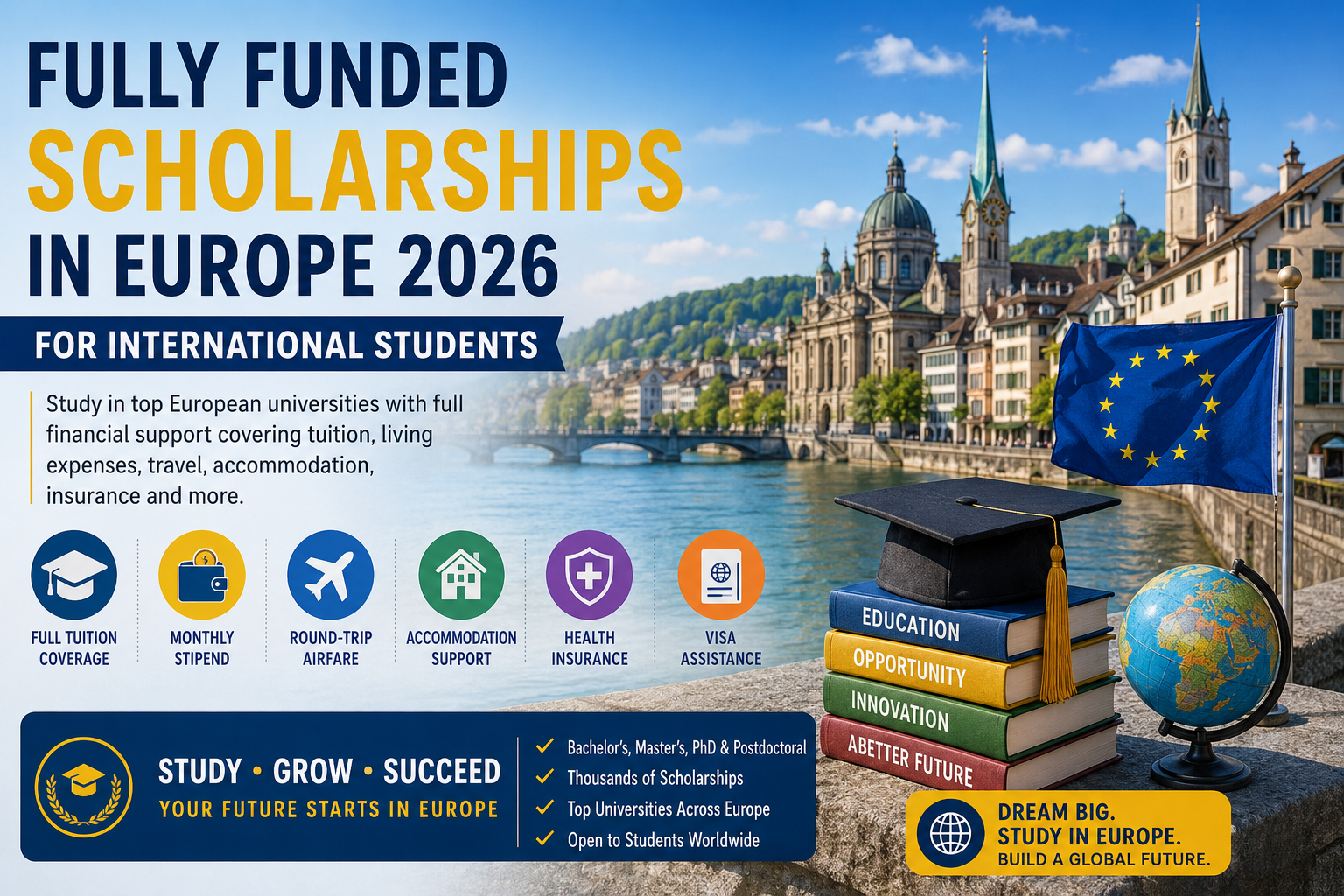
Fully Funded Scholarships in Europe 2026 for International Students
Many of the world’s brightest children and students dream of going to Europe to study. But the fees, living expenses, travel, health insurance, and visa costs are very high, making it difficult for many students. The good news is that Fully Funded Scholarships in Europe 2026 help thousands of students every year.
These scholarships cover student fees, monthly expenses, accommodation, airfare, health insurance, and other educational expenses. These programs are provided by the European Union, governments, and major universities so that students can pursue bachelor’s, master’s, PhD, and research degrees at good universities.
In this guide, you will learn about the best fully funded scholarships in Europe in 2026, what are the requirements, what documents are required, how to apply, and what important things to remember for success. If you are interested in engineering, medicine, business, social sciences or arts, this information is useful for you.
Table of Contents
- Introduction to Fully Funded Scholarships in Europe 2026
- Why Study in Europe?
- Salient Features of European Scholarships
- Popular Fully Funded Scholarships of 2026
- Best Scholarship-Awarding Countries
- Eligibility Criteria
- Required Documents
- How to Apply
- Best Tips for Success
- Ways to Avoid Common Mistakes
- Examples of Successful Students
- Pros and Cons of Studying in Europe
- Who Can Apply?
- Conclusion
Full Information, Benefits, and Popular Scholarship Programs
A fully funded scholarship is an educational aid that covers almost all the costs of studying abroad.
A fully funded scholarship is an educational award that covers almost all the costs of studying abroad. Partial scholarships only help with fees, but fully funded scholarships cover most of the student’s expenses so they can study easily.
Most scholarships in Europe include the following benefits:
- Full tuition fees
- Monthly living allowance
- Round-trip airfare
- Accommodation assistance
- Health insurance
- Visa assistance
- Research and travel expenses
- Contribution to thesis and conference expenses
Europe is a popular destination for students from all over the world to study. It offers a good education, diverse cultures, cutting-edge research, and internationally recognized degrees. Countries like Germany, France, Italy, the Netherlands, Sweden, and Belgium offer various scholarships to international students.
Why study in Europe?
Students in Europe get quality education, the opportunity to learn new cultures, and good job prospects in the future. Universities there offer modern facilities and an international atmosphere.Excellent education
Europe has some of the most famous universities like Oxford University, ETH Zurich, University of Amsterdam, and Sorbonne University.
Low-cost education
Many European countries charge little or no fees. If you get a full scholarship, education becomes almost free.
Programs in English
Thousands of bachelor’s, master’s and PhD programs in Europe are taught in English, making it easier for students from other countries to study.
Better job opportunities
After completing their studies, students can get a work permit and good job opportunities in Europe.
Experience new cultures
Studying in Europe allows students to learn new languages, different cultures and new ideas, which improves both their personality and education.
Key Highlights of Fully Funded Scholarships in Europe 2026
Feature |
Details |
| Scholarship Type | Fully Funded |
| Study Levels | Bachelor’s, Master’s, PhD, Postdoctoral |
| Eligible Applicants | International Students from Around the World |
| Coverage | Tuition Fees, Monthly Stipend, Airfare, Insurance |
| Application Period | Mostly from September 2025 to March 2026 |
| IELTS Requirement | Optional at Some Universities |
| Number of Opportunities | Thousands of Scholarships Across Europe |
| Funding Sources | European Union, Governments, and Universities |
Requirements for Fully Funded Scholarships in Europe 2026
Each scholarship has its own requirements, but most scholarships have some things in common. If you understand these things in advance, it will be easier to prepare a good application.
Good academic performance
Most scholarships prefer students with good grades. A good GPA or percentage is very important for Masters and PhDs. Scholarships like Erasmus Mundus and DAAD especially select intelligent students.
Language skills
Many European universities teach in English, so tests like IELTS, TOEFL or Duolingo may be required. Some universities even waive this requirement if previous studies were in English.
Related education
Most programs require an academic background in the same subject. For example, if a student wants to do a Masters in Data Science, he or she should have a background in Computer Science, Mathematics, Statistics or Engineering.
Leadership and other activities
Scholarships like Chevening and the Swedish Institute favor students who participate in extracurricular activities, such as volunteering or community service.
Work experience
Some scholarships also require one to three years of work experience, especially in programs related to leadership or public policy.
Research ability
For PhD and research programs, universities look at your research, publications, and recommendations.
Country-specific requirements
Some scholarships are only open to students from specific countries, so be sure to check the rules before applying.
Documents required for scholarships
It makes applying easier if you have your documents ready in advance.
Required Documents
- Academic Certificates and Degrees
- Copy of Passport
- Updated CV
- Statement of Purpose (SOP)
- Letter of Motivation
- Research Proposal (for PhD)
- Letters of Recommendation
- English Test Scores if required
- Work Experience Certificates
- Portfolio (for Art and Design)
- Passport Size Photographs
- Financial Documents if requested
Statement of Purpose (SOP)
In this you write about your studies, future goals, why you like the program and your dreams.
Letter of Motivation
This explains why you are interested in this scholarship and why you are a good candidate.
Letters of Recommendation
Get a letter from a teacher or supervisor who knows you well and can write good things about you.
CV
A CV should be clear and concise. It should include education, experience, research, skills and other activities.
How to Apply for Fully Funded Scholarships for Europe 2026
Step 1: Find the right scholarships
Find scholarships that suit your education, subject, and country.
Step 2: Select universities and programs
Find universities that offer your preferred course. Check out information about their education, faculty, and facilities.
Step 3: Check requirements and deadlines
Always check the official website of the university and scholarship as the rules may change every year.
Step 4: Prepare your documents early
Prepare your certificates, recommendations, and SOP well in advance to avoid any hassle later.
Step 5: Make each application unique
Don’t use the same SOP for each scholarship. Try to make each application specific to that scholarship.
Suggested Application Timeline for Europe Scholarships 2026
| Timeline | Recommended Activities |
| May–July 2025 | Research scholarships and universities |
| August–September 2025 | Prepare your SOP, CV, and recommendation letters |
| September–December 2025 | Submit applications for major scholarships |
| January–March 2026 | Complete remaining applications and attend interviews |
| April–June 2026 | Receive results and start the visa process |
| August–September 2026 | Begin your academic studies in Europe |
Real Success Story
A Pakistani student completed his degree in Electrical Engineering from a government university. His home environment was not very good, but he got good grades, volunteered in technology workshops, and even did a small research project on renewable energy.
The student started preparing eight months before the deadline. He made a good CV, got two strong letters of recommendation, and wrote a good SOP. In it, he explained that he wanted to solve the electricity problems in South Asia by studying sustainable energy.
He applied to Erasmus Mundus, DAAD, and Stipendium Hungaricum. Later, he got a fully funded Erasmus Mundus scholarship. It covered fees, travel, insurance, and monthly expenses.
This example tells us that a great university is not the only thing that is necessary to get a good scholarship. Good intentions, hard work, and a good application are more important.
Small example: Why a good personal story is important
Scholarship providers don’t just look at grades. They also look at how the student will help people with their education.
For example, if a public health student says they want to improve maternal health in impoverished areas, their application is considered stronger.
The best applications have these things:
- A clear problem the student wants to solve
- Relevant education and experience
- Clear future goals
- A description of how the scholarship will help them achieve those dreams
Pros and Cons of Fully Funded Scholarships in Europe
| Pros | Cons |
| Covers most or all education expenses | Very competitive selection process |
| Opportunity to study at top universities | A lot of documents are required |
| International exposure and networking opportunities | Different deadlines need careful planning |
| Better career and job opportunities | Some scholarships have strict requirements |
| Support for research and innovation | Interviews may be part of the process |
| Chance to work after graduation in some countries | Application process can take a lot of time |
Who can apply for the Europe 2026 Fully Funded Scholarships?
These scholarships are especially good for:
Which students are they best for?
- Students with good grades
- Students who want to do a Masters or PhD
- People with leadership potential
- Researchers with new ideas
- Students who need financial support
- People who want to solve world problems
Who may need more preparation?
- Students with low grades
- Students whose goals are not yet clear
- Candidates who have few recommendations or required documents
- Last-minute applicants
Even if a student’s profile is not complete, he or she can still apply. Good writing, good experience, and a clear goal can strengthen the application.
Comparison of Major Scholarship Programs
| Scholarship | Best For | Typical Coverage | Study Level |
| Erasmus Mundus | Students interested in studying in multiple European countries | Tuition fees, monthly stipend, travel costs, insurance | Master’s |
| DAAD | Study and research opportunities in Germany | Monthly stipend, insurance, travel expenses | Master’s, PhD |
| Chevening | Professionals with leadership potential | Tuition fees, stipend, travel expenses | Master’s |
| Swedish Institute | Students aiming to become future global leaders | Tuition fees, stipend, travel support | Master’s |
| Stipendium Hungaricum | Students from different academic fields | Tuition fees, stipend, accommodation support | Bachelor’s, Master’s, PhD |
Frequently Asked Questions
- Can international students study in Europe for free?
Yes, many fully funded scholarships cover fees, living expenses, travel and insurance.
- Is IELTS required?
Not always. Some universities also accept prior education in English.
- What is the most popular scholarship in Europe?
Erasmus Mundus is considered to be a very popular fully funded scholarship in Europe.
- Are there fully funded scholarships for PhD students?
Yes, DAAD, Swiss Government Excellence Scholarships and other research scholarships support PhD students.
- When should you start preparing?
It is best to start preparing six to twelve months before the deadline.
summary
Fully funded scholarships in Europe 2026 offer international students a great opportunity to study abroad. Scholarships such as Erasmus Mundus, DAAD, Chevening and Stipendium Hungaricum cover fees, living expenses, travel and insurance. Good preparation, a strong application and timely submission of documents are essential for success. If you do your research well and choose a scholarship that suits your purpose, your dream of studying in Europe can come true.
Conclusion
Studying in Europe is no longer just a dream. There are thousands of fully-funded scholarships available in 2026 that will allow students from all over the world to study in top universities.
The important thing is to start preparing early, prepare good papers, and apply for scholarships according to your studies.
Whether you want to study engineering, science, or public policy, there are great opportunities in Europe. With hard work, preparation, and courage, you can achieve your dream.