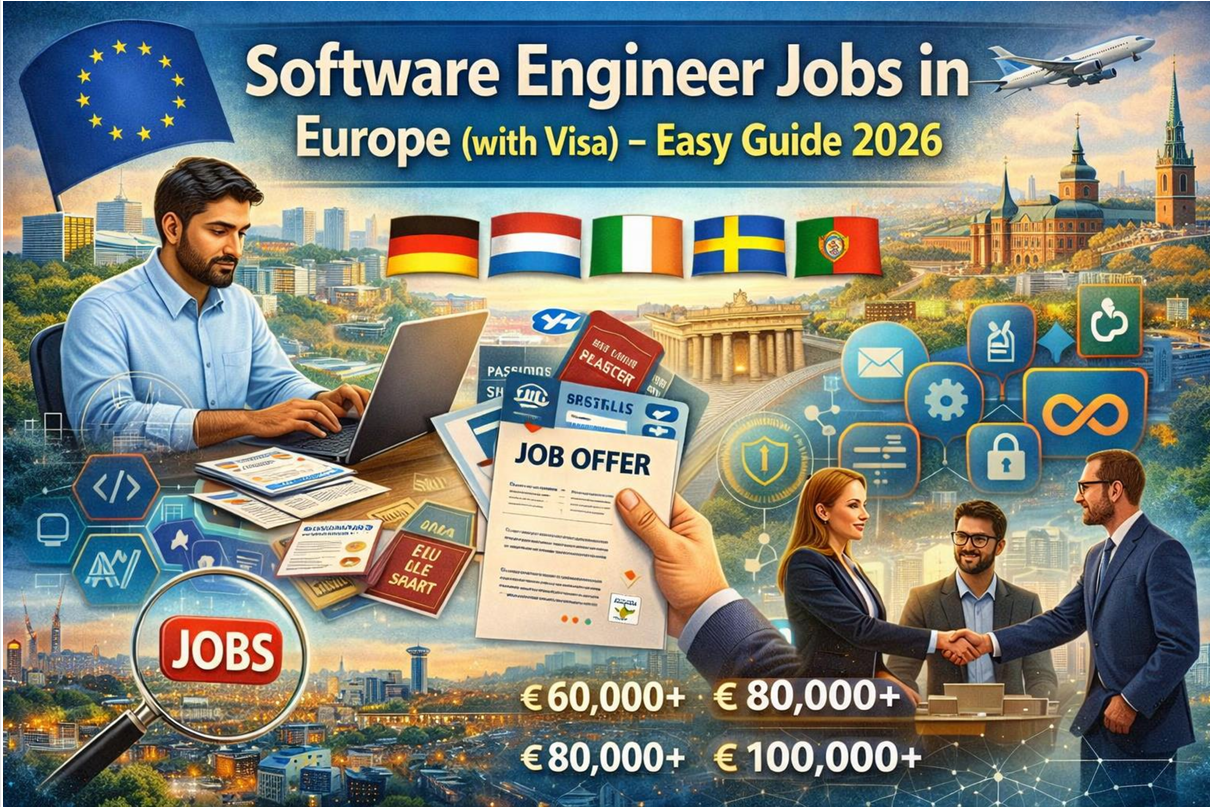
Software Engineer Jobs in Europe (with Visa) – Easy Guide 2026
Many people in the world dream of working in Europe. There is a good job, good salary and a good life. But there is one problem: you need a visa to work there.
That is why “visa sponsored” jobs are very important. This means that the company itself helps you with your visa.
Many European countries like Germany, Netherlands, Ireland, Sweden and Portugal are in great need of software engineers. That is why they are willing to give jobs to people from other countries.
But finding the right job and understanding the visa process can seem a bit difficult. In this guide, we will explain everything in an easy way.
What will you learn?
This guide will help you understand:
- Which European countries have the most jobs
- How to get a visa
- Where to find a job
- What skills are needed
- Easy ways to succeed
Whether you are a new learner or an experienced professional, this guide will help you.
A simple overview of jobs in Europe
Technology has grown rapidly in Europe in the past few years. Cities like Berlin, Amsterdam, Dublin, Stockholm and Lisbon have now become major technology hubs.
That is why there is a huge demand for software engineers there. But they don’t have enough people to do all the work, so they invite people from other countries.
What is visa sponsorship?
This means that the company offers you a job and also helps you with your visa. They help you prepare your documents so that you can easily move to the country.
What types of jobs are available?
There are different types of jobs in Europe, such as:
- Website development (front-end and back-end)
- Cloud computing
- DevOps
- Artificial intelligence (AI)
- Cybersecurity
- Mobile app development
- Working with dataWhat are the good things?
Many companies also offer:
- Travel allowance
- Accommodation
- Visa fee assistance
Why is there so much demand?
European countries are working a lot on new technologies, such as AI and cloud systems. Therefore, they need software engineers and this need will continue to grow.
The best countries in Europe in 2026 where software engineers can get jobs with visas
Not every country in Europe is the same. Every place has its own laws, salaries and way of working. But there are some countries where it is easy to give jobs to outsiders and also get visas.
Let’s understand in a simple way:
Germany
Germany is a big tech country in Europe. Cities like Berlin, Munich and Hamburg are very famous here.
Why is it good?
- There are a lot of jobs
- There are big companies
- Good salary
- It is relatively easy to get a visa
Germany has a special visa called the “EU Blue Card”, it is for skilled people.
Which jobs are more?
- Back-end developer
- DevOps engineer
- Cloud engineer
- AI and data jobs
Netherlands
This country is special because most people here speak English.
Why is it good?
- Work gets done in English
- Good salary
- Good work-life balance
- New tech companies
Visas are available here through the “Highly Skilled Migrant” program.
Ireland
Ireland has a lot of big tech companies, especially in the city of Dublin.
Why is it good?
- Lots of jobs
- English environment
- Good salary
- Work with big companies
Jobs are available here through the “Critical Skills” visa.
Sweden
Sweden is very advanced in technology, especially the city of Stockholm.
Why is it good?
- Life is great
- Work environment is good
- Family-friendly
- Companies hire expatriates
Portugal
Portugal is becoming increasingly popular, especially in Lisbon and Porto.
Why is it good?
- Living is relatively cheap
- New companies are coming
- Remote work opportunities
- Easy immigrationTypes of visas (in simple terms)
When you apply for a job in Europe, it is important to know about visas.
EU Blue Card
This is a special visa for skilled people.
What is needed for it?
- Degree or good experience
- Job from a company
- Good salary
Its advantages:
- Can stay for a long time
- Can get permanent residence later
- Can also invite familySkilled worker visa
Many countries issue this visa so that skilled people can come from abroad.
This is for people who have a shortage of jobs there, like software engineers.
Software Engineer Salary in Europe in 2026 (in simple terms)
When someone thinks of moving abroad, the first question that comes to mind is: How much will they get paid?
Salaries in Europe are not the same. It depends on things like:
- Which country are you moving to
- Which city is the job in
- How much experience do you have
- Is the company big or small
The salaries in Europe may not be as high as in the US, but life here is easy, safe and balanced.
Salary in different countries (in simple terms)
Germany
- Newbie: Approximately 50 to 65 lakh rupees per year (in euros)
- Intermediate experience: 65 to 85 lakh
- Senior: 85 to 110 lakh
Netherlands
- Newbie: 48 to 60 lakh
- Intermediate: 60 to 80 lakh
- Senior: 80 to 105 lakh
Ireland
- Newbie: 50 to 65 lakh
- Intermediate: 65 to 90 lakh
- Senior: 90 to 120 lakh
Sweden
- Newbie: 45 to 60 lakh
- Intermediate: 60 to 80 lakh
- Senior: 80 to 100 lakh
Portugal
- Newbie: 30 to 45 lakh
- Intermediate: 45 to 65 lakh
- Senior: 65 to 85 lakh
(These are all estimates, the actual salary may be lower or higher. (can)
What makes salaries higher?
City
Big cities like Dublin, Amsterdam, and Berlin pay more.
Company
Big companies and rich startups pay more.
Special skills
You get paid more if you know these things:
- AI (artificial intelligence)
- Machine learning
- Cybersecurity
- Cloud computing Additional benefits (not just salary)
Many companies also offer:
- Bonus
- Company shares
- Assistance with housing or travel
Benefits of working in Europe
- Work-life balance
People in Europe don’t just work, they enjoy life too.
- 20–30 holidays a year
- Finish work on time
- Relaxed environment
- Work from home opportunity
- Good treatment (healthcare)
Treatment in Europe is good and easy.
Most companies or governments help.
- Working with people from different countries
You work with people from different nations.
This allows you to:
- Learn new things
- Improve your English
- Make friends from all over the world4. Opportunities for advancement
By working in Europe, you can:
- Work on big projects
- Learn new technologies
- Can join big companies
A simple example (true story)
Raja Bilal was a software engineer with 5 years of experience.
He knew Python and cloud computing.
What did he do?
- Improve his CV
- Showcase projects
- Apply to companies in Germany and the Netherlands
After a few interviews, he got a job with a company in Berlin.
The company:
- Get him a visa
- Give him a place to live
- Help with paperwork
- A few months later, he was happily working.
How to increase your chances of getting a job in Europe? (Easy ways)
Just applying is not enough
You have to be better than others so that the company likes you.
Here are some easy and great ways:
- Create your good portfolio
A portfolio means a place to show your work.
Companies look at your work, not just your words
What should you do?
- Put your projects on GitHub
- Work in open source
- Write documentation to explain your work
- Show examples of solving problems
The more real work you show, the more chances you will have
- Fix your LinkedIn profile
LinkedIn is the place where companies also find you.
What should you do?
- Write a clear title (e.g.: “Backend Engineer | Python”)
- Describe your projects
- Include certificates and links
- Turn on “Open to Work”
- Target the right companies
Not every company provides visas
Find a company that:
- Works in English
- Has people from different countries
- Has a remote or international team
- Has a visa or relocation written in the job post
This will save you time and increase your chances
- Prepare well for the interview
Interviews are very important
What should you do?
- Practice coding
- Learn algorithms
- Understand system design
- Practice live coding
- Have examples of your previous work ready
The company sees that you can only write code or understand it
- Know about visas in advance
The company helps, but you should also know the basics.
For example:
- What is an EU Blue Card
- What are the visa requirements
- How much salary is required
This makes you look confident in the interview
Common mistakes (to avoid)
Sending the same application to everyone
It is wrong to send the same CV to every company
What to do?
- Change your CV for each job
- Write according to the company’s needs
Forgetting the time zone
Europe has different time zones
What to do?
- Check the interview time carefully
- Respond quickly
Not understanding the culture
Each country has a different way of working
What to do?
- Speak politely
- Show teamwork
- Respect the opinions of others
Understanding relocation is easy
It is not easy to move to another country
What to ask?
- Who will provide accommodation?
- How will a bank account be created?
- What will the company help with?
Summary
Summary This guide explains how you can get a software engineer job in Europe, that too with a visa Some European countries such as: Germany, Netherlands, Ireland, Sweden and Portugal have a high demand for software engineers.